
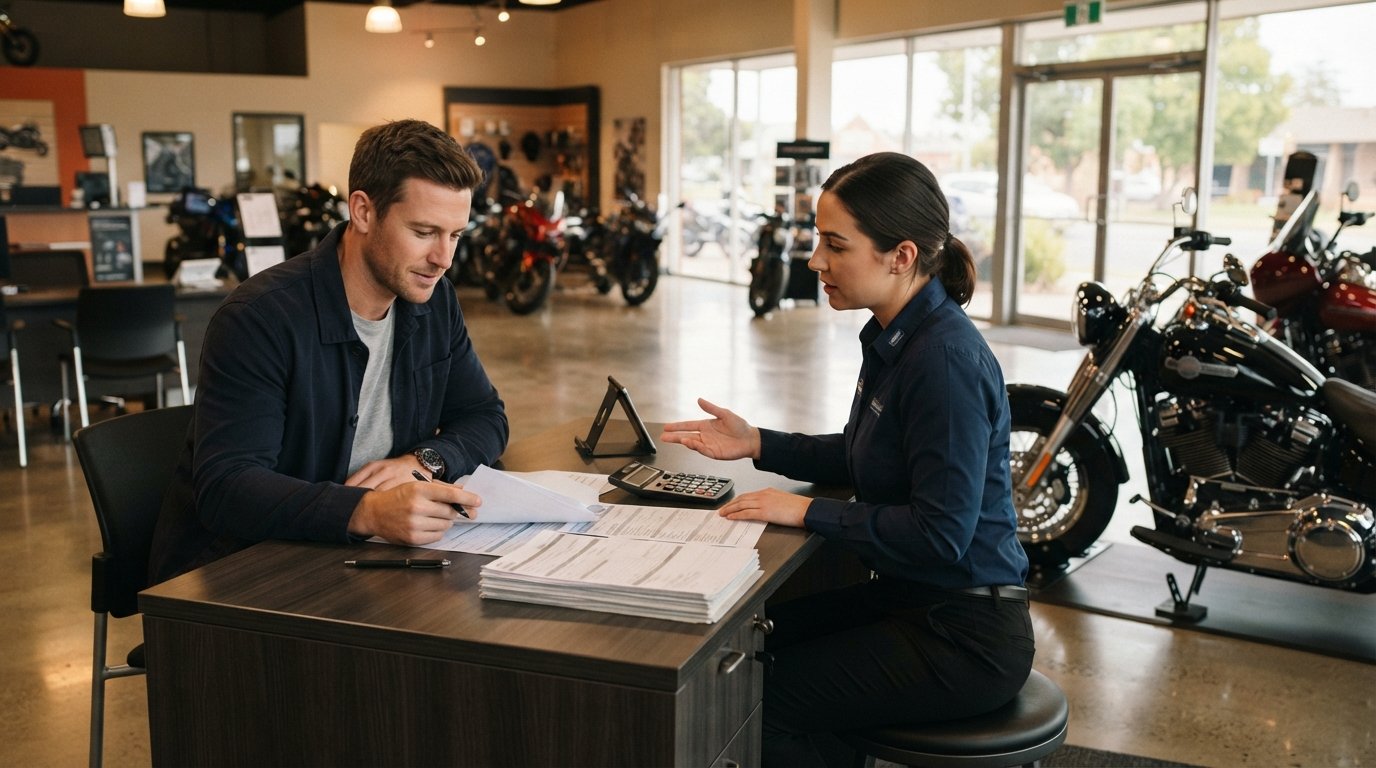
Motorcycle Financing With Bad Credit: Down Payment Rules
Motorcycle financing with bad credit down payment requirements vary by credit tier. See typical ranges, lender differences, and steps to lower your cash requirement.

You have found the bike you want, but your credit score is not where you would like it to be. Now the real question surfaces: how much cash will a lender demand before handing over the keys? For riders with imperfect credit, the down payment is often the single biggest hurdle between a dealership hello and a signed contract. The good news is that motorcycle financing with bad credit down payment requirements are not arbitrary. Lenders publish ranges, follow risk models, and respond predictably when you understand what they are looking for. This guide breaks down those expectations by credit tier, lender type, and paperwork strength so you can walk into a dealership or submit an online application with a realistic plan instead of a hope.
Typical Down Payment Ranges by Credit Tier
Motorcycle lenders sort borrowers into rough credit bands, and each band carries its own down payment expectation. These ranges are not universal, but they reflect what most major lenders and dealership finance departments use when structuring deals for riders with challenged credit. Generally, the weaker the credit profile, the higher the percentage of the purchase price the lender wants to see paid upfront. That upfront cash reduces the lender's exposure if the bike is repossessed and resold, since motorcycles depreciate quickly and have a smaller resale market than cars.
Here is a practical breakdown of what riders typically encounter across credit tiers for new and used motorcycles:
- Excellent credit (720+): 0% to 10% down, often with promotional zero-down offers on new models.
- Good credit (660 to 719): 10% to 15% down, sometimes negotiable with strong income documentation.
- Fair credit (600 to 659): 15% to 25% down, with the higher end applying to used bikes and longer terms.
- Poor credit (500 to 599): 25% to 35% down, frequently with proof of income and references required.
- Very poor or thin credit (below 500): 35% to 50% down, or a co-signer to reduce the requirement.
These percentages apply to the total financed amount, not just the sale price. Taxes, registration, dealer fees, and accessories can push the out-the-door cost higher, and lenders typically calculate the down payment against that final figure. A rider who budgets 20% of the sticker price may discover the actual required cash is closer to 25% once fees are included. Always ask the finance manager to quote the down payment as a dollar amount against the out-the-door total, not as a percentage of the advertised price.
How Lender Type Changes Down Payment Expectations
Not every lender treats bad credit the same way, and the type of institution you approach will significantly shape the cash requirement. Understanding these differences helps you target the right funding source instead of wasting applications on lenders that were never going to approve your profile. The three main categories are banks, credit unions, and specialty finance companies, each with a distinct appetite for risk.
Traditional banks tend to be the strictest. They often set hard credit score floors, and if your score falls below that line, no down payment amount will move the application forward. Banks also prefer newer motorcycles with clean titles and may cap loan terms to keep the bike from going upside down. Credit unions sit in the middle. They are member-owned, so they can be more flexible with riders who have an established relationship, and some offer first-time buyer or credit-builder motorcycle loans with down payments in the 15% to 20% range. Specialty finance companies and dealership finance departments are the most accommodating for bad credit, but they offset that risk with higher down payment requirements, sometimes 30% or more, and higher interest rates.
There is a practical lesson here: applying to the wrong lender type wastes time and creates unnecessary credit inquiries. A rider with a 560 score and 20% down is a strong candidate at a specialty lender and a weak candidate at a traditional bank. If you are exploring how credit history shapes approval across vehicle types, the same risk logic applies to refinancing for bad credit borrowers, where lenders weigh equity and payment history just as heavily as the original credit score.
Documents and Proof of Income That Strengthen a Thin Application
A down payment is only one part of the approval equation. Lenders also want evidence that you can repay the loan, and for borrowers with bad credit, that evidence carries extra weight. A strong document package can sometimes reduce the down payment requirement by a tier because it lowers the lender's perceived risk. Conversely, a missing document can stall an otherwise approvable deal.
Before you apply, assemble a folder that answers the lender's core questions: who you are, what you earn, and whether you pay your obligations. The most commonly requested items include:
- Government-issued photo ID and proof of residence (utility bill or lease agreement).
- Recent pay stubs covering at least 30 days, or two years of tax returns if self-employed.
- Bank statements showing the down payment funds have been in your account, not borrowed.
- Proof of motorcycle insurance, since most lenders require full coverage before funding.
- References with contact information, which specialty lenders often call to verify stability.
Proof of income deserves special attention. Lenders calculate a debt-to-income ratio, and a rider with bad credit but a stable job and low existing debt can look far better on paper than the score alone suggests. If your income is variable, gather three to six months of statements to show consistency. If you receive disability, pension, or gig income, document it clearly. The goal is to remove any reason for the underwriter to doubt your ability to make the monthly payment, because doubt translates directly into a higher down payment demand.
Why Total Cost of Ownership Matters More Than the Down Payment Alone
It is tempting to focus entirely on scraping together the down payment and ignore what comes after. That is a costly mistake. The down payment is a one-time hurdle, but the loan term, interest rate, insurance premium, and maintenance schedule determine whether the motorcycle remains affordable for years. Riders with bad credit often face interest rates several percentage points higher than prime borrowers, and on a longer term, that difference can add hundreds or even thousands of dollars to the total cost.
Consider a $12,000 motorcycle financed over 48 months. A prime borrower at 6% pays roughly $282 per month and about $1,530 in total interest. A subprime borrower at 15% pays roughly $334 per month and about $4,030 in total interest. The down payment difference between the two scenarios might be $2,000, but the interest difference alone nearly matches it. Add insurance, which is typically higher for financed bikes because lenders require full coverage, and the true cost gap widens further. Before committing, use an auto loan calculator to model the full term, not just the monthly payment.
Insurance is a frequently overlooked line item. Lenders require comprehensive and collision coverage on financed motorcycles, and riders with bad credit sometimes pay higher premiums because insurers use credit-based insurance scores in most states. Shopping for coverage before you finalize the loan can reveal whether the total monthly obligation fits your budget. Resources that explain how to compare free auto insurance quotes online can help you benchmark premiums across carriers so the insurance bill does not become the reason the bike gets parked.
Steps to Improve Approval Odds Before Submitting an Application
Walking into a dealership cold and hoping for the best is not a strategy. A few deliberate moves in the weeks before you apply can improve your position and potentially reduce the cash the lender demands. These steps are especially valuable for riders whose credit history includes late payments, collections, or a recent bankruptcy.
Start by pulling your credit reports from all three bureaus and disputing any errors. A single incorrect collection account can drop a score by dozens of points, and correcting it may move you into a better down payment tier. Next, save beyond the minimum down payment. A lender who sees 30% down when the guideline calls for 25% has less reason to scrutinize the rest of the file. Then, get pre-qualified with two or three lenders before visiting a dealership, since pre-qualification typically uses a soft credit pull and lets you compare offers without damaging your score.
Here is a practical sequence to follow in the four to six weeks before you apply:
- Review all three credit reports and file disputes for inaccurate negative items.
- Pay down revolving balances to lower your credit utilization ratio.
- Save a down payment that exceeds the guideline for your credit tier by at least 5%.
- Gather income, residence, and insurance documents into a single folder.
- Get pre-qualified with multiple lenders and compare the full loan cost, not just the rate.
After pre-qualification, resist the urge to apply everywhere. Each formal application can trigger a hard inquiry, and a cluster of inquiries in a short window makes lenders nervous. Choose the offer that balances a manageable down payment with a term you can realistically pay off. If the only offers available carry punishing rates, consider waiting a few months, improving your credit profile, and reapplying. A motorcycle is a want, not a need, and time is on your side when you use it to strengthen your file.
Finally, remember that the down payment conversation is a negotiation, not a verdict. Dealership finance departments sometimes have flexibility on the cash requirement if the rest of the application is strong, and a co-signer with good credit can often reduce or eliminate the down payment premium entirely. Ask directly what would move your deal into a better tier, and be prepared to walk away if the terms do not fit your budget. The right lender will meet you where your finances actually are, and the wrong one will simply confirm why you should keep shopping.